
Sell Shovels, Not Gold
During the California Gold Rush of 1848, most people scrambled to mine gold. Samuel Brannan did something different. He bought every mining pan in the region at $0.20 each and sold them for $15. Nine weeks, $36,000, California’s first millionaire. Not by mining. By enabling miners.
The AI gold rush is following the same pattern. And most platforms are making the miner’s mistake.
Everyone Rushed to Mine
Notion added Notion AI. Canva built Magic Studio — twelve AI tools. Adobe embedded Firefly into Photoshop. Microsoft put Copilot in every Office app. Zoom added AI meeting summaries. Slack added AI channel digests.
The pitch was always the same: “Now with AI.” Every platform rushed to put AI inside their walls, hoping it would keep users locked in — and paying more.
The results? Generic content. Summaries that miss what matters. Designs that look like everyone else’s. You can’t choose a different model, can’t customise the prompts, can’t control the output. You get what they give you.
This is the self-checkout machine of AI.
The Self-Checkout Problem

Think about self-checkout at a supermarket. QR code ordering at restaurants. Airport check-in kiosks. These are sold as “smart technology.” They’re the opposite — cost-shifting disguised as innovation. The work that trained staff used to do is now pushed onto you. Every confusing interface, every “please try again” is friction being created, not eliminated.
Platform AI features follow the same logic. “Here, use our AI tool” shifts the work of getting good results onto you. Learn our prompts. Accept our limitations. Pay our premium. It’s a self-checkout machine with an AI label.
What I actually want is the opposite. I want my AI — one that knows my preferences, my style, my standards — to operate across all these services. I don’t want Notion’s AI writing for me. I want my AI writing in Notion.
Build Doors, Not Walls
For that to work, platforms don’t need AI features. They need doors — APIs, protocols, interfaces that let external AI agents interact with their systems.
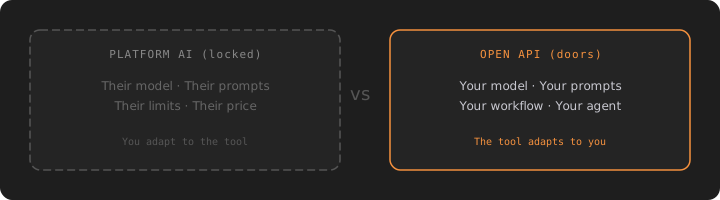
Shopify gets this. They’ve built MCP servers, agentic storefronts, and a Universal Checkout Protocol. AI agents from ChatGPT, Perplexity, and Google AI can browse products, complete purchases, and interact with merchants — all through open protocols. No proprietary AI feature. Just doors.
Shopify didn’t build a better AI. They built better access for your AI. That’s selling shovels.
And here’s what most platforms haven’t grasped: I can build their features myself. With vibe coding I can build a writing assistant, a design generator, an analytics dashboard. Code isn’t the moat anymore. But data, integrations, ecosystem — those are worth paying for. If I can access them through my own tools.
The building blocks are already emerging. Anthropic’s MCP (Model Context Protocol) is becoming the USB port for AI — a standard interface that lets any model interact with any tool. Shopify, Notion, and Block are already supporting it. Google’s A2A (Agent-to-Agent) protocol tackles the next layer — how agents from different companies discover each other, exchange capabilities, and coordinate tasks.
This matters because most AI frameworks today solve the wrong problem. Tools like LangGraph and CrewAI help developers orchestrate agents. That’s useful. But the real challenge isn’t combining your own agents — it’s enabling agents from different organisations to talk to each other. That requires protocols, not frameworks. Whether MCP and A2A become the universal standard — like USB did — or fracture into competing specs, is still unclear. But the direction is right: open protocols over proprietary features.
The Concierge Future

But even APIs aren’t the end of the story. APIs are like a self-service shop with well-organised shelves — better than a locked warehouse, but you still have to find things yourself.
The real end state is a concierge.
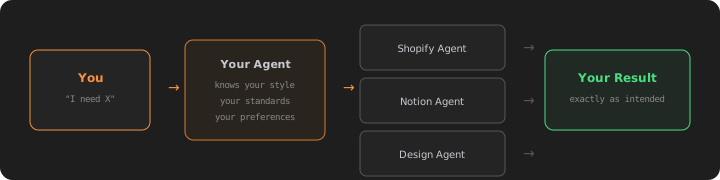
I believe everyone will eventually have a personal AI agent — one that knows your habits, preferences, and standards. When you need something done, you tell your agent. It doesn’t learn every platform’s API. It talks to the platform’s agent.
Like a hotel concierge. You don’t study restaurant menus, call the taxi company, or negotiate with the theatre. You tell the concierge what you want. The concierge knows who to call and how to get it done.
This is how human society already works. We don’t do everything ourselves. We find the right person for each task and communicate intent. AI should work the same way — your generalist agent talks to specialist agents, each an expert in their own domain.
For this to work, platforms need to stop building AI for users and start building AI about their own systems — specialist agents that truly understand every feature, every edge case, every integration. My agent talks to their agent. The result is what I intended. No learning curve. No self-checkout.
The Real Question
Steve Jobs said: “Simple can be harder than complex. You have to work hard to get your thinking clean to make it simple.” Apple’s products never asked users to learn technology. They made technology disappear into the task.
That’s the standard. A simple question reveals whether a platform meets it: is the AI serving the user, or serving the platform?
If the AI only works inside the platform, requires a premium subscription, can’t be replaced with your own model, and has no API for external agents — it’s serving the platform. It’s a retention tool with an AI label.
If the platform opens its doors and lets your AI interact on your terms — that’s the one I’ll pay for. Not for their AI. For their transparency.
The platforms that understand this will build doors. The rest will keep mining while someone else sells the shovels.
Read next: You Need the Box Before You Can Think Outside It | How to Choose a Vibe Coding Tool