The Wrong Question
Most people choosing between platforms and custom sites ask: which is easier to set up?
That was the right question five years ago. It’s the wrong question now.
The right question in 2026 is: how well does your site work with AI?
Not “does it have an AI feature.” But: can AI read your entire site, understand its structure, modify its design, add new features, create content from your actual work, and deploy changes — all through conversation?
If your site is on Squarespace or WordPress, the answer is no. Your content is behind a proprietary editor. Your design is locked in a template. AI can help you write a blog post, but it can’t publish it, style it, or build a payment system around it. You’re still the middleman, copying and pasting between tools.
What AI-Native Actually Means
This site — deTrouble — is what I’d call AI-native. Not because it uses AI features. Because every layer is transparent to AI.
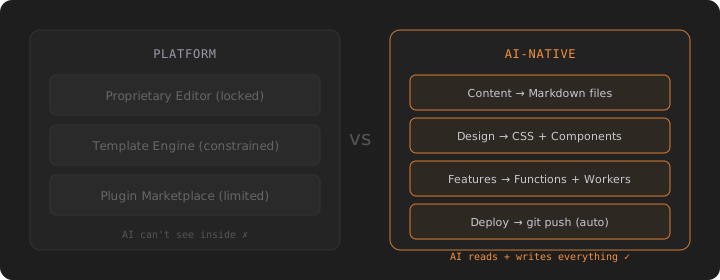
The entire site is plain files. Content is Markdown. Design is CSS. Configuration is one file. Deployment is git push. No database. No admin panel. No proprietary format. Claude Code — or any AI coding tool — can read and modify all of it.
That’s not a technical detail. It’s the entire point.
Content That Writes Itself (Almost)
Here’s the workflow that made me stop considering platforms entirely.
I do R&D and development using Claude Code. During that process, it naturally accumulates context: project code, planning documents, conversation history, decisions made along the way. When it’s time to write about what I built, I don’t start from scratch. I say:
“Analyse this project, our conversation, and the decisions we made. Write an article about it.”
Claude Code already has the context. It produces a draft — structured, fact-checked, in both English and Chinese. I review, give feedback, iterate. The article you’re reading was created exactly this way.
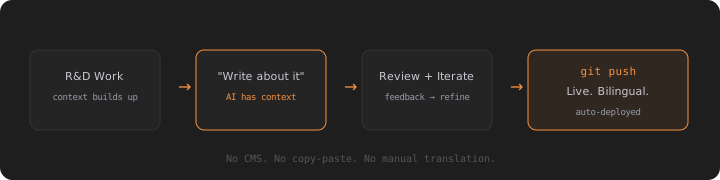
Then: git push. Live on the site. No CMS login. No manual translation. The content creation pipeline is the same as the development pipeline. That’s only possible because AI can see everything.
On a platform, you ask ChatGPT to write something, then manually paste it into the editor, manually format it, manually translate it, and manually hit publish. Every step is a disconnection. Every disconnection is friction.
Features Through Conversation
Content is just the beginning. When you need new capabilities on a platform, you search for a plugin — maybe it exists, maybe it costs $20/month, maybe it almost does what you want.
On an AI-native site, you have a conversation. “Add Stripe checkout” becomes a Cloudflare Worker handling webhooks. “Add analytics” becomes one component. “Add a login system across all my subdomains” becomes an auth Worker with D1 and shared cookies.
The pattern is always the same: describe what you need → AI implements it → git push → live. No marketplace. No plugin compatibility issues. The constraint isn’t what the platform allows. The constraint is what you can describe.
The Compounding Advantage

Here’s what most comparisons miss: this advantage compounds over time.
Month 1, your custom site and a Squarespace site look similar. But by month 6, your site has evolved through dozens of conversations — new features, refined design, content generated from your actual work. The Squarespace site looks the same, or you’ve spent hours fighting the template to make small changes.
Every conversation with Claude Code adds to its understanding of your project. The memory system retains your preferences, your architecture decisions, your content style. The next change is faster than the last.
A platform doesn’t know your project. It doesn’t learn from your decisions. It’s the same template engine on day 300 as it was on day 1.
When This Doesn’t Apply
Honesty matters. This approach isn’t for everyone.
It’s best for people who can clearly describe what they want, who create content regularly, and who want a site that evolves. You don’t need to code — but you need to think clearly about what you’re building.
It’s not ideal if you need Shopify-level e-commerce today, if your team needs a visual CMS for non-technical editors, or if you want zero involvement with the technical layer. For those cases, platforms are still the right call.
The Point
The real shift isn’t “build vs. buy.” It’s transparency.
A platform is a black box. You put content in, a website comes out. You can’t see inside. AI can’t see inside.
An AI-native site is transparent all the way down. Content is files. Design is code. Features are functions. Everything is readable, modifiable, and extensible — by you or by AI.
The question isn’t whether you can build your own site. With vibe coding, anyone who can describe what they want can build one. The question is whether you want a site that grows with you, or one that stays exactly where the platform left it.
Read next: How to Choose a Vibe Coding Tool | You Need the Box Before You Can Think Outside It