
Parse — Thinking Method Finder
Describe a messy situation. Parse recommends the right thinking method and gives you a prompt you can use immediately. Learn 67 methods through scenarios, not textbooks.
Launch App →The Problem
You know AI can help you think. But when you say “help me figure out my priorities,” the AI gives you a generic to-do list. When you say “run a RICE analysis on these 5 features,” the AI knows exactly what to do — score Reach, Impact, Confidence, Effort, output a ranked table.
The difference isn’t the AI. It’s whether you know the right thinking method for the problem you’re facing.
There are hundreds of frameworks, mental models, and methodologies. Nobody has time to study them all. But if you don’t know they exist, you’re stuck using brute force on problems that have elegant solutions.
Three Modes
Parse gives you three ways in.
Situation Analysis
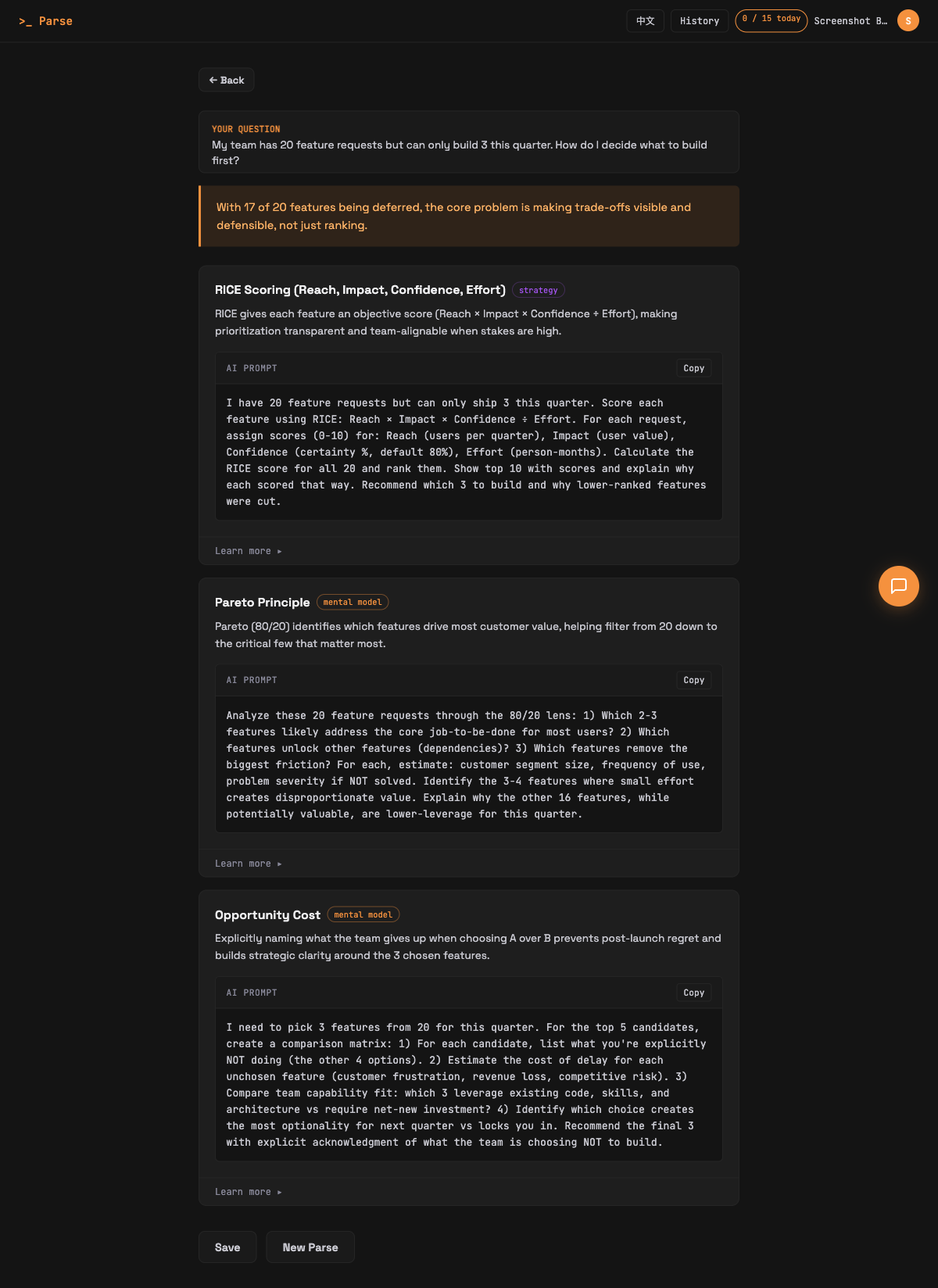
Describe your messy situation in plain language. Parse’s AI identifies the type of problem and recommends 3 methods from a taxonomy of 67 tools — each with a prompt you can paste directly into Claude or ChatGPT.
The prompt isn’t generic. It embeds your specific context so the AI can act on it immediately.
Learn
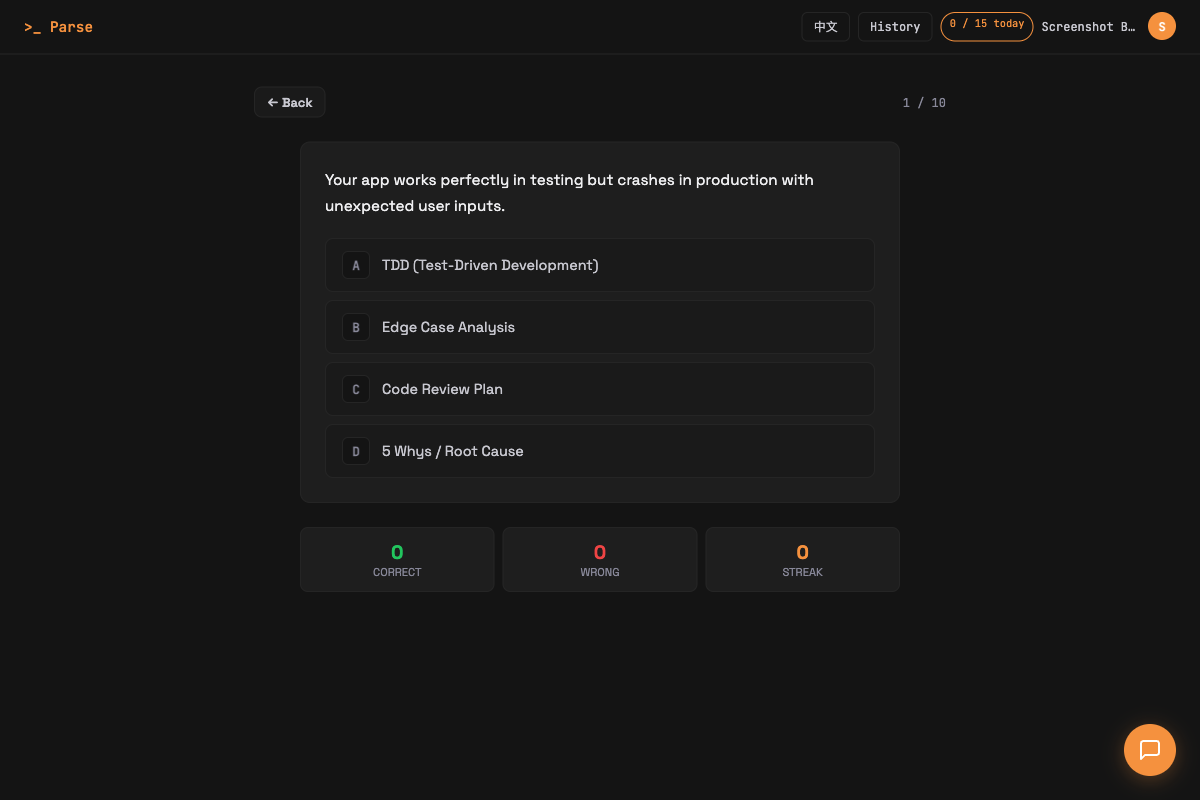
Interactive quiz. You read a realistic work scenario and pick which thinking method fits best. After answering, you see why that method works and how to apply it step by step.
Wrong answers get higher priority in future sessions — spaced repetition until you remember. Progress syncs across devices when logged in.
68 scenarios covering all 67 methods. Not flashcards — real situations you’ll actually face.
Browse
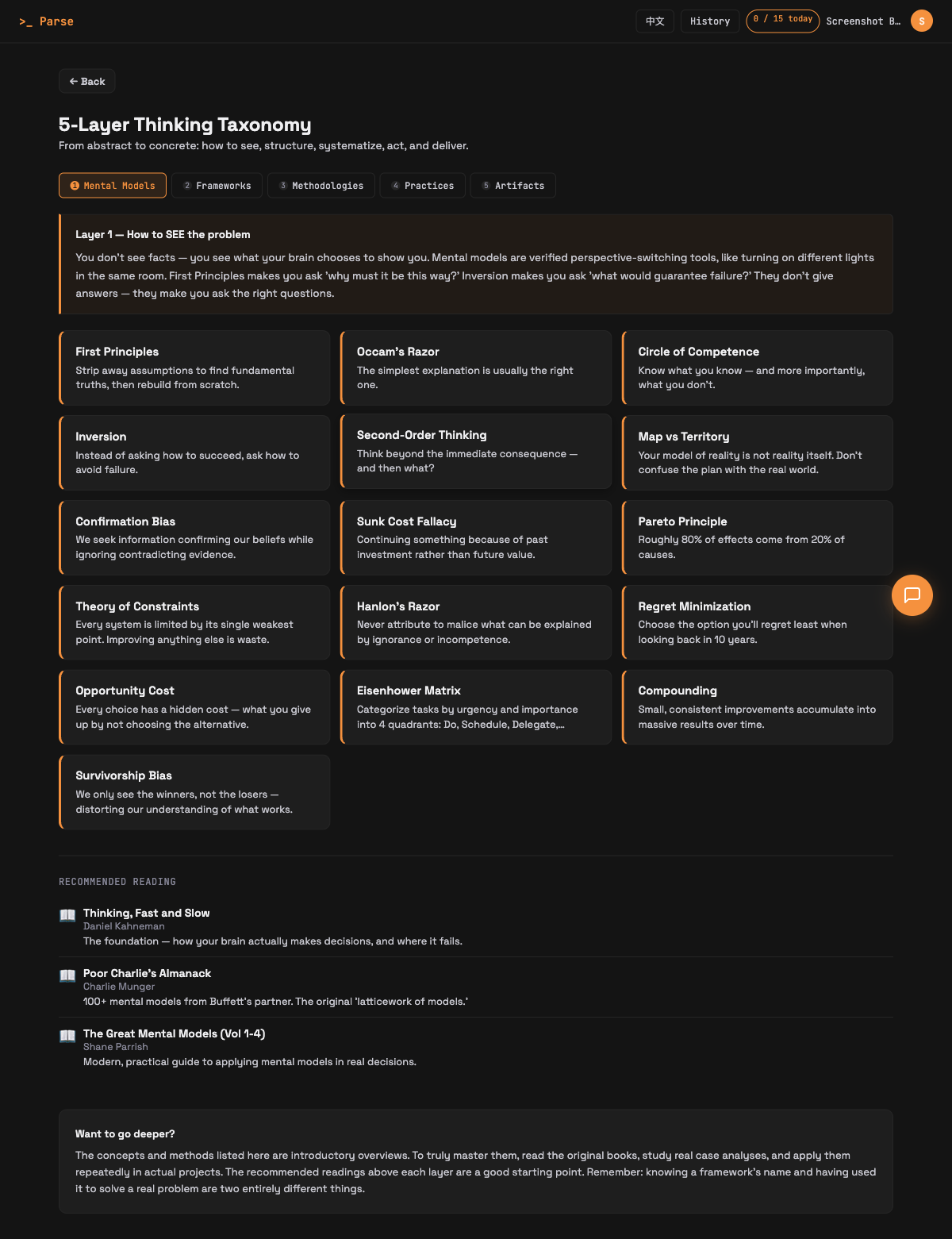
All 67 methods organized across 5 layers — from abstract to concrete:
- Mental Models — How to see the problem (First Principles, Inversion, Pareto, etc.)
- Frameworks — How to structure the analysis (RICE, ADR, SWOT, PRD, etc.)
- Methodologies — What system to follow (Agile, Lean Startup, Design Thinking, etc.)
- Practices — What to do tomorrow morning (Retrospective, Timeboxing, 5 Whys, etc.)
- Artifacts — What to produce (Decision Records, SOPs, Technical Specs, etc.)
Each method has: what it is, why it works, a real scenario, a thought-provoking question, and a prompt template.
AI Chat
Have a question about a concept? Not sure which method fits your specific case? The chat (bottom-right corner) connects you to an AI that knows all 67 methods, all the articles on deTrouble, and can reason through your situation.
Use it to:
- Ask about the difference between two similar methods
- Get advice on how to apply a method to your specific context
- Explore ideas before committing to a formal analysis
Documents Have Names
There’s a gap people miss: the output format. You tell AI “write something up about this decision.” AI gives you three paragraphs of prose.
But if you say “write an Architecture Decision Record,” AI produces: Title, Status, Context, Options Considered, Decision, Consequences. A format your future self can actually trace back to.
Parse teaches you these document types exist. Once you know ADR, PRD, SOP — every AI interaction produces structured output your team can build on, not disposable text.
What Changes After Using Parse
- You recognize problem types: prioritization, decision, process, strategy
- You know which tool fits each type
- Your AI conversations become dramatically more productive
- You stop going in circles and start making structured progress
Parse doesn’t think for you. It teaches you how to think — one problem at a time.